
Natural Variability Is Larger Than Advertised
A Review of Paleoclimate Data Challenging the “Unprecedented Warming” Narrative

Over the past month, I have done something increasingly rare in public climate discourse. I stepped away from headlines, institutional summaries, and model visualizations and went back to the primary literature itself… ice cores, speleothems, marine sediments, isotope datasets, proxy methodology papers, and modern synthesis studies spanning multiple regions of the planet.
This was not a casual review. It was a deliberate, weeks-long immersion into dozens of peer-reviewed studies across Greenland, Antarctica, Asia, the North Atlantic, and continental hydrological archives. As someone formally trained as an isotope geochemist, these records are not abstract talking points to me. They are the empirical foundation of how we reconstruct past climate in the absence of direct measurements.
And that absence of direct measurements is critical.
Reliable global surface temperature coverage is sparse before the mid-20th century. Satellite observations of atmospheric temperature extend back only a few decades. From a geological perspective, this is an extraordinarily short observational window. Yet sweeping claims about “unprecedented warming” are routinely made using this narrow slice of time, while the far longer proxy record, the only record we actually have for deep climate context, is often reduced to smoothed global averages.
If modern warming is truly unprecedented in rate and magnitude, that signal should be unmistakable across the full paleoclimate archive, not just within a short instrumental record or an aggregated global mean curve.
But after a month inside the primary literature, a very different picture emerges.
What Institutional Narratives Actually Claim
To be precise, the modern climate narrative does not merely argue that warming is occurring. It frequently asserts that recent warming is unprecedented in the historical context. The IPCC AR6 Summary for Policymakers, for example, states that global temperature increases are “unprecedented in at least the last 2000 years,” a phrase widely echoed in media coverage and institutional communications.
This framing is largely derived from hemispheric or global multiproxy reconstructions. While scientifically valuable, these reconstructions rely on spatial averaging, temporal smoothing, and standardization across diverse proxy types. By design, these methods reduce variance and suppress high-frequency regional variability.
That distinction matters because the high-resolution proxy literature, the actual ice cores, isotope records, and sediment archives often tell a far more dynamic story than smoothed global composites suggest.
A Personal Note: Why This Review Matters to Me
Long-time readers of IrrationalFear will recognize that this line of inquiry is not new in my work. Across more than 435+ articles, I have repeatedly examined proxy uncertainties, temperature reconstruction limitations, and the misuse of global average temperature as a singular climate metric.
In my earlier articles, I discussed in detail how proxy records are constructed, the assumptions embedded within them, and the resolution limits that can smooth rapid variability in ice cores and other climate archives.
As an isotope geochemist, I view climate history through δ¹⁸O curves, sediment layers, and geochemical proxies… not just modern temperature graphs. These records are messy, regional, and assumption-laden, but they are also the only empirical datasets that extend back thousands to hundreds of thousands of years.
And those records consistently show a climate system defined by variability, not stability.
A Reminder: Proxies Are Not Perfect
At the same time, we have to be honest about proxy limitations.
In one well-known cave study from Moondyne Cave in Australia that I discuss in “Science or Speculation? The Uncomfortable Truth About Climate Proxies”, the oxygen isotope signal (δ¹⁸O) in a speleothem did not track temperature in the way commonly assumed. In some intervals, the isotope signal moved opposite to instrumental temperature. Rainfall patterns and moisture source effects overwhelmed the temperature signal.
That example does not invalidate paleoclimate research. But it reminds us of something crucial… Proxy records are complex. They encode multiple environmental variables. They require interpretation.
One Foundational Example: Greenland Ice Core Variability
In the early 1990s, independently drilled Greenland ice cores — GRIP and GISP2 — revealed something extraordinary. Their oxygen isotope records showed repeated, large, and rapid climate shifts during the last glacial period. (Grootes et al., 1993)
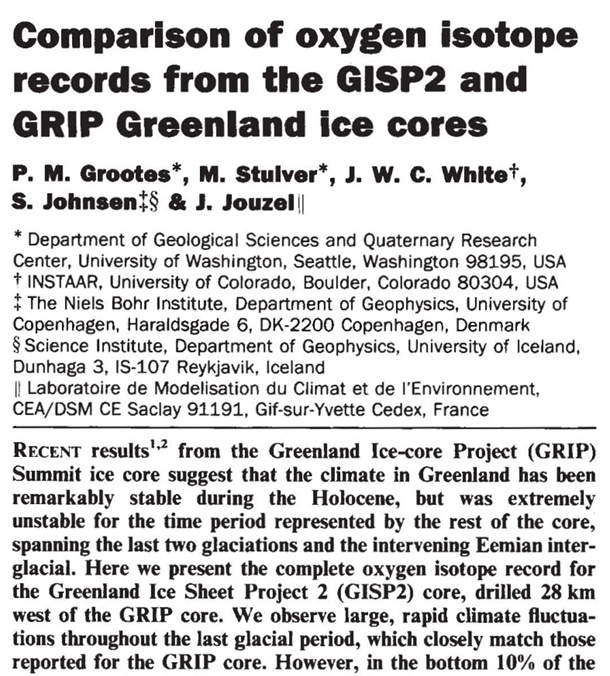
These are not subtle variations buried in noise. They are pronounced shifts in oxygen isotope ratios corresponding to major temperature changes occurring on decadal timescales, with glacial-interglacial differences estimated on the order of 10–13°C. Even more importantly, these signals are replicated across independently drilled cores with extremely strong agreement, confirming that the variability reflects real climatic behavior rather than analytical artifact.
That single dataset alone challenges the idea of a historically stable climate suddenly experiencing unprecedented change.
But Greenland is only the beginning.
On Rates of Change: A Critical Context Often Ignored
A common argument is that past climate changes were either too slow or too regional to be comparable to modern warming. However, the high-resolution proxy record complicates this assumption.
Greenland ice cores document Dansgaard–Oeschger events involving temperature shifts of several degrees occurring over decades. Likewise, the termination of the Younger Dryas involved substantial and rapid warming in high-latitude regions. These findings demonstrate that abrupt climate shifts are not unique to the industrial era.
This does not imply that past and modern climate changes are identical in cause or global coherence. Rather, it shows that the Earth system is capable see-sawing, rapid reorganizations driven by internal variability, ocean circulation changes, and nonlinear feedbacks.
Global Averages vs Regional Climate Reality
Another issue repeatedly encountered during this month-long review is the heavy reliance on global average temperature as the primary metric of climate change. Global means are statistical constructs that smooth spatial variability and reduce extremes.
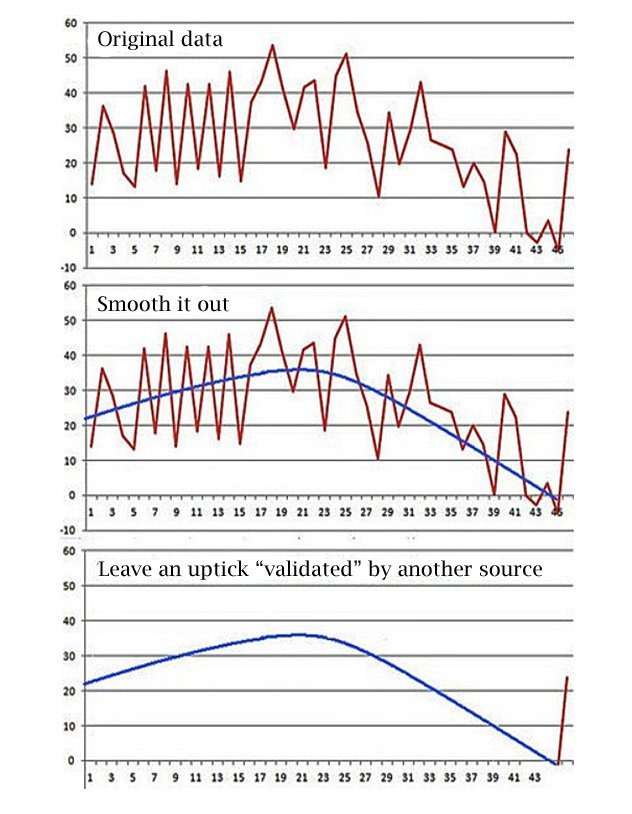
By contrast, proxy records are inherently regional and preserve the true dynamical behavior of the climate system.
Proxy archives — ice cores, speleothems, and marine sediments — also contain intrinsic smoothing due to diffusion, depositional processes, and temporal resolution limits. This means that even the large variability observed in the paleoclimate record may represent conservative estimates of actual past climate dynamics rather than exaggerated signals.
After reviewing dozens of studies across multiple proxy systems and regions, a consistent pattern emerges: abrupt climate variability is not an anomaly in Earth’s history. It is a recurring feature.
What the Full Literature Review Shows
In the subscriber section below, I walk through the primary literature directly — paper by paper, figure by figure, and region by region — including:
Greenland ice core abrupt warming events
Heinrich events and ocean circulation disruptions
Bipolar seesaw climate synchronization
Speleothem isotope records of monsoon variability
Continental hydrological reorganizations
Modern synthesis studies on abrupt climate dynamics
Proxy resolution and smoothing effects that suppress variability
Subscribers also receive access to my full archive of 435+ data-driven articles analyzing climate datasets, proxy records, and geochemical evidence using primary literature rather than summaries or institutional interpretations.
If the claim that modern warming is truly unprecedented is robust, it should withstand direct comparison with the full paleoclimate record.
Below, we conduct that comparison using the literature itself.
